Sanjay Gandhi sterilization campaign
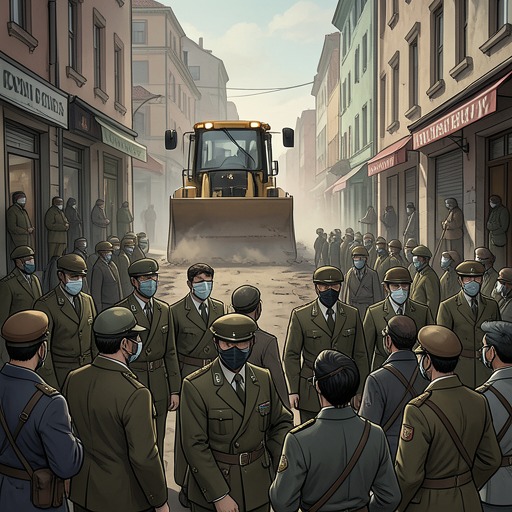
Midnight's ChildrenThe Sanjay Gandhi sterilization campaign is portrayed as a defining instrument of coercive rule during the Emergency: a policy presented through the language of public improvement becomes an operation against vulnerable residents, backed by organized volunteers and troops. In the magicians’ ghetto, the campaign turns a promised evacuation into forced sterilization and a violent roundup; later, the narrator links its broader political machinery to the persecution and imprisonment of the Midnight’s Children.
Political Background
Sanjay Gandhi and his wife, Menaka, were prominent during the Emergency, and the Sanjay Youth Movement was particularly effective in the sterilization campaign. The novel places this fact within a political account that distinguishes the Emergency’s visible, publicly documented face from its hidden, coercive one. The contrast matters: the campaign does not arrive as an openly declared assault, but under the cover of administrative language and claims of social benefit.
The narrator’s account of Indira Gandhi further frames the political setting. He explains that her surname came from her marriage to Feroze Gandhi, not from a family relationship to Mahatma Gandhi, and notes that by 1975 she had been a widow for fifteen years. He then draws attention to the significance of the capitalized word “Widow,” which becomes his name for the ruling power associated with the Emergency. This framing connects the campaign to a wider concentration of political authority, while the account of the Sanjay Youth Movement identifies the machinery used to carry sterilization into practice.
The Ghetto Operation
The campaign reaches the magicians’ ghetto through vans and bulldozers, followed by a loudspeaker announcing an authorized civic beautification operation and ordering residents to evacuate without dissent. The public justification casts the settlement as an eyesore. Yet the arrival of surgical equipment and camp beds gives the evacuation a second, more threatening meaning. The narrator recognizes the operation as sterilization, and a warning spreads among the residents to protect women and children.
Young volunteers arrive in coordinated groups, but their polished appearance does not make the operation voluntary. Residents are seized and dragged toward the vans. The people targeted include magicians and elderly beggars, while children who had been playing in the ghetto join the resistance by throwing stones. The official description of beautification thus stands in sharp contrast to the residents’ experience of being rounded up for a bodily intervention they did not choose.
Picture Singh rallies the magicians. His umbrella, formerly associated with harmony, becomes a weapon as the residents organize their defense. They throw Molotov cocktails and bricks, and Picture Singh leads an assault on the sterilization tent. Parvati is at Saleem’s side during the confrontation. The resistance does not stop the operation: troops are sent in against the inhabitants, and Saleem is separated from Parvati as the soldiers charge and people are forced toward the waiting vans.
Violence and Saleem’s Arrest
The narrator presents the ghetto’s resistance as a brief reversal, not a victory. The residents’ improvised weapons and collective action drive the volunteers back, but the state responds with armed troops. During the resulting chaos, Saleem sees a contortionist fall and residents being pulled toward the vans. He then understands that the ghetto clearance is also the cover for a personal pursuit: Shiva has joined the assault and is looking for him.
This convergence of sterilization and roundup makes the operation more than a public-health measure within the story. It places the residents under direct state force while denying them meaningful choice, and it allows an attack on the community to conceal the capture of an individual. Saleem is arrested in the course of the assault, but the surviving account does not explain why he is detained. He later observes that those imprisoned during the Emergency were not generally told why they had lost their freedom.
Imprisonment and Consequences
While imprisoned, Saleem is pressured by two interrogators and gives them names, addresses, and descriptions of the Midnight’s Children. He calls this a betrayal: as founder of the Conference, he presides over its end by helping the authorities identify its members. His account places that personal act within a wider pattern of Emergency detentions, for which he reports estimates ranging from thirty thousand to a quarter of a million people. The Widow dismisses the prisoners as only a small percentage of India’s population, a formulation that makes mass loss of liberty sound administratively negligible.
The children of midnight are subsequently rounded up and brought to the Widows’ Hostel between April and December. Their fate extends the campaign’s coercive logic beyond the ghetto confrontation: state power reaches a group Saleem had tried to organize, and his disclosures help expose them to that power. In his cell, he hears their whispers through the walls and grieves over the consequences of his confessions. The narrative leaves the campaign’s consequences inseparable from the Emergency’s broader detention and persecution of those who have been made politically vulnerable.
Narrative Significance
The episode is told through Saleem’s retrospective, fragmentary narration, which repeatedly marks the limits of what he can recover. Elsewhere, he describes memory as scraps that must be fitted together from partial clues; the ghetto climax likewise comes through recollected images, official announcements, and moments of confusion rather than a detached administrative account. That form matters because the campaign is encountered from below, through the experience of the people swept into its operation and the later guilt of a narrator who has himself been compelled to disclose others.
Across Saleem’s memories, political violence also returns through bodily and sensory fragments: his grandfather survives the Jallianwala Bagh massacre when a sneeze makes him fall, and Saleem later recalls a painful episode of childhood secrecy through what he sees and hears from inside a washing-chest. These earlier memories do not describe the sterilization campaign, but they establish a narrative pattern in which overwhelming events are understood belatedly and through fragments. Against that pattern, the ghetto operation becomes both a concrete instance of Emergency coercion and part of a life repeatedly shaped by violence, secrecy, and incomplete knowledge. The novel’s central contrast is between official explanations that promise order and the lives those explanations conceal or expose to force.